
Most companies treat greenhouse gas verification as a compliance checkbox. It is closer to an insurance policy for every number in a sustainability report.
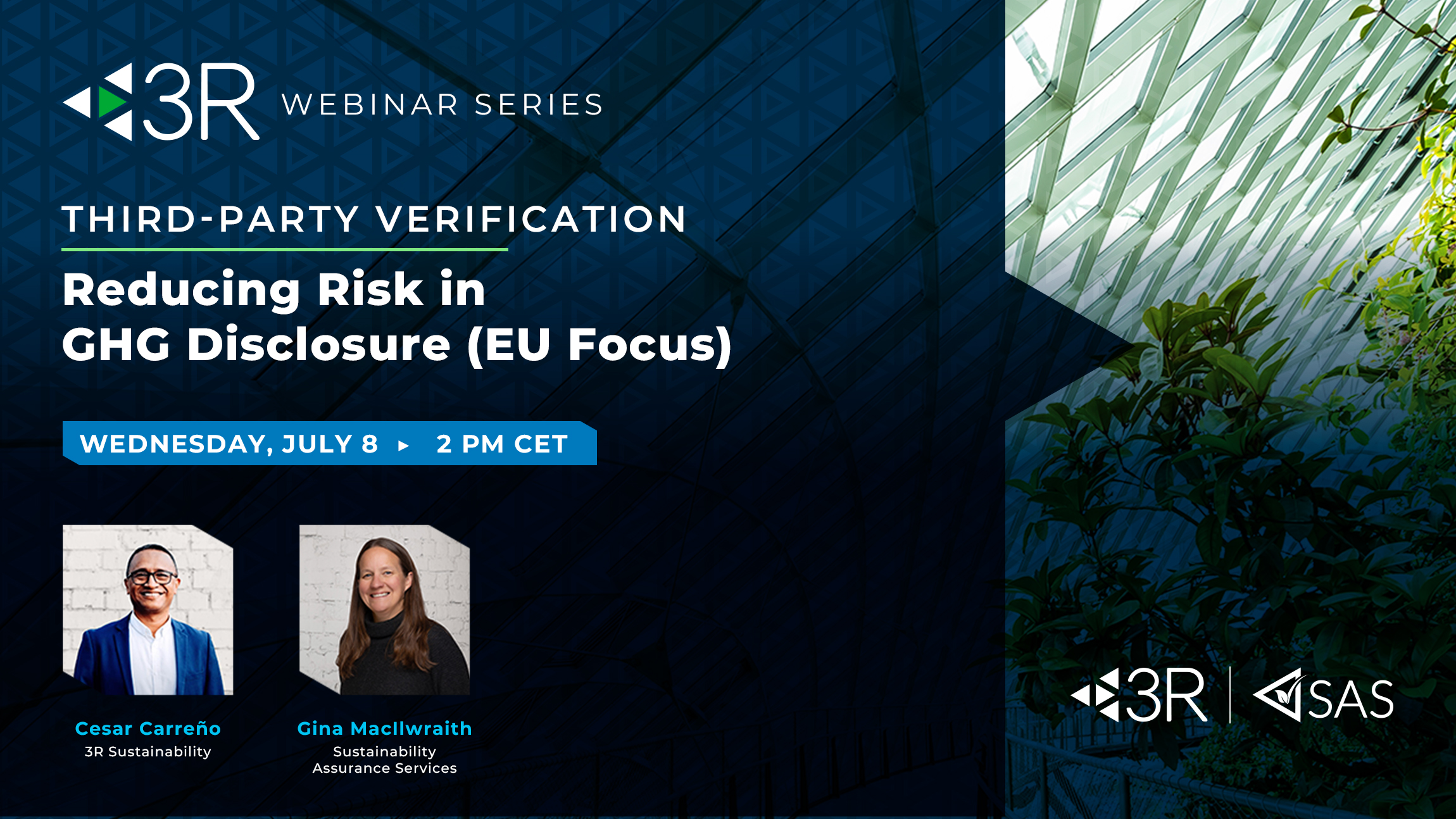
In a recent 3R Sustainability and Sustainability Assurance Services (SAS) webinar, presenters Cesar Carreño and Gina MacIlwraith walked through what verification actually checks, where companies most often stumble, and how one verified inventory can support multiple disclosure frameworks at once.
Key Takeaways
- Verification is historical (checking what already happened); validation is forward-looking (checking a planned project); assurance is the final statement that ties the two together.
- Assurance runs on three standard families: AA1000 (principles-based, whole management system), the accounting-world standards (ISAE 3000/3410, ISSA 5000), and the ISO standards (ISO 17029, ISO 14064).
- A verification typically takes two to eight weeks and moves from a limited (“nothing looks materially wrong”) level to a reasonable (“the data is right”) level as a program matures.
- Data organization, not the calculation itself, is where most companies struggle: inconsistent utility bills, outdated emission factors, and unit-conversion errors are the most common findings.
- One AA1000 or ISO 14064 verification can support CDP, GRI, CSRD/ESRS E1, EcoVadis, and B Corp disclosures at the same time, so a single exercise carries weight across every program a company reports to.
Watch the Recording of our Webinar
Cesar Carreño-Chasin of 3R and Gina MacIlwraith of 3R’s assurance partner, Sustainability Assurance Services (SAS), explore how verification against ISO 14064 and AA1000 can reduce reporting risks, strengthen stakeholder confidence, and support regulatory and voluntary disclosure requirements.
What Verification Actually Checks
Gina MacIlwraith opened with the three terms that get used interchangeably and shouldn’t be. Validation looks forward, confirming that a planned project, an emissions-reduction initiative, for example, is designed to deliver what it claims. Verification looks backward, confirming that a completed activity, most often a GHG inventory, is accurate. Assurance is the output: a statement or report describing the verifier’s confidence in the data.
A GHG verification reviews five areas: the inventory boundaries and emission sources, the underlying data and calculations, data management and quality controls, the approval process, and, ultimately, the conformity opinion itself. Verifiers select a representative sample of emission sources, recalculate the inventory independently, and compare results against a materiality threshold, typically 10 percent for a first verification, tightening toward 5 percent as a program matures.
Where Companies Actually Struggle
Asked directly where companies struggle most, MacIlwraith did not point to the math. She pointed to data organization and collection, especially reading utility bills consistently and knowing which emission factors a software platform is applying and whether those factors are current. A calculation platform is only as reliable as what gets entered into it. Verification exists to catch exactly that gap before a regulator, rating agency, or investor does.
Why This Matters for CDP, EcoVadis, and CSRD
Verification is not a one-program cost. CDP’s climate change module asks directly whether Scope 1, 2, or 3 emissions are externally verified and rewards it toward a higher climate leadership score. EcoVadis requires a verification statement to reach a full score on the environmental theme. CSRD goes further: external assurance on Scope 1, 2, and 3 data is mandatory under the regulation, and in some EU member states, unverified or materially inaccurate disclosures carry personal liability risk for company officers.
Because these frameworks largely draw on the same underlying standards, AA1000 and ISO 14064 chief among them, one verification exercise can support all of them at once. That is the practical argument for verifying before a mandate forces the issue rather than after.
The Real Risk Verification Prevents
The session closed on the risk categories a verification catches early: material misstatement, incomplete inventory boundaries, regulatory non-compliance, ESG disclosure risk, inaccurate climate targets built on an unverified baseline, and, for investors, financial risk from underwriting a deal on emissions data that turns out to be wrong. An unverified baseline does not just risk an audit finding. It risks every target and every investment decision built on top of it.
Companies preparing for CDP, EcoVadis, CSRD, or a first SBTi target should treat verification as the foundation those efforts stand on, not a step to add once every framework requires it.
Ready to talk through where your organization stands? Reach out to 3R Sustainability’s Climate and Assurance teams to scope a GHG verification or a readiness assessment before your next reporting cycle.

Assurance doesn’t have to be intimidating
Our partner, Sustainability Assurance Services (SAS), provides third-party verification and assurance of sustainability-related data and reporting.
How 3R can help
3R works at the intersection of ESG, climate, building performance, and reporting, helping clients realize the value of sustainability across their organizations and assets through goal setting, action planning, and accurate reporting.
Our consulting and assurance divisions are both recognized as CDP Accredited Solutions Providers.
3R supports organizations with:
- Greenhouse gas (GHG) inventory creation and review
- CDP preparation and questionnaire submission
- Sustainability reporting strategy and support
- GHG inventory verification
- Sustainability assurance services
By combining strategic consulting support with assurance capabilities, 3R helps organizations strengthen disclosure quality, improve reporting readiness, and support more defensible sustainability reporting outcomes.