

Run through the specificities of Essential Criteria and understand how to prepare your submission to minimize non-compliance
By Cesar Carreño
In 2024, CDP introduced Essential Criteria (EC), and disclosers were not 100% ready for it. Through different announcements, CDP communicated that these changes were to be implemented during the 2024 reporting cycle for all disclosers, as previously they applied to A-listers only.
A great majority of disclosers, who were not properly informed about the EC, suffered drastic setbacks on their scoring and hence in the public perception of their efforts. According to Net Zero Tracker, this causes a deep dive in the number of companies that are willing to publicly share their score versus the companies that disclose within CDP.
In 2023 (Pre Essential Criteria) and with 21,000 disclosers, around 61% of the disclosers were willing to publicly share their scores. In 2024, the number of disclosers increased by 6,000, but only 25% had decided to publicly share their scores. By 2025, the number of disclosers fell by 7,000, and while the percentage of disclosers remained stable, the volume of available data was not the same.
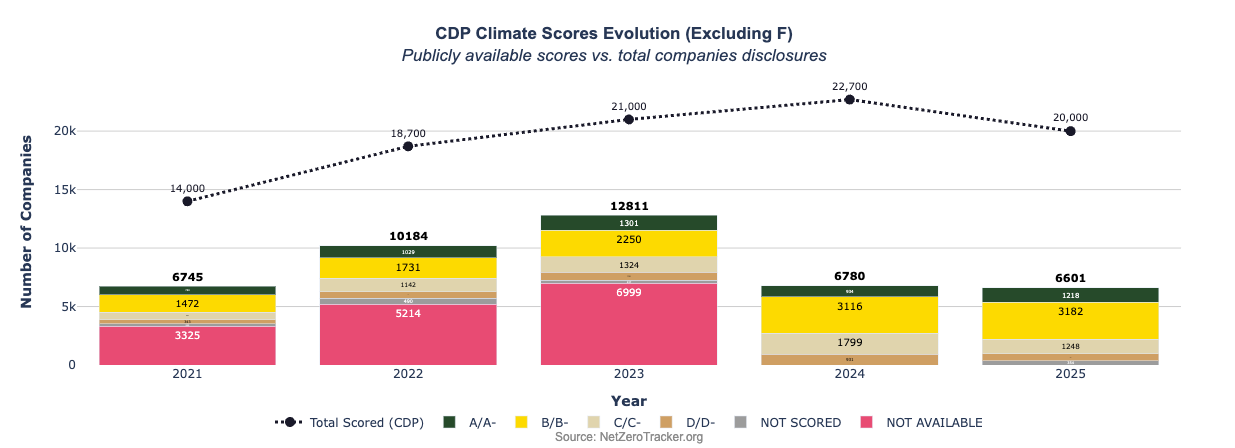
CDP Climate Scores Evolution (Excluding F) – publicly available scores vs. total companies’ disclosures (Source: Net Zero Tracker)
The main goal of the Essentia Criteria is to streamline the scoring process. To increase your score, you must ensure that you’ve met all the requirements from the previous level (e.g., Disclosure to move to Awareness). This pushes companies to mature their sustainability programs in more impactful ways as opposed to learning to report more strategically to score more points. Many organizations see this as a major challenge, either due to limited capacity, limited data availability, or financial reasons.
Every year, CDP updates the scoring guidance and includes some changes from the previous year to support transparent reporting. While those changes are typically released in April, the following can be expected from CDP in the 2026 Disclosure Cycle:
- Disclosers will be able to opt in to disclose specific topics during the questionnaire setup (e.g., Plastics, Ocean, and SME)
- Guidance will be updated for Corporations and Small to Medium Enterprises (SMEs)
- Disclosures will be able to pre-populate the submission based on the previous year’s responses
- Companies disclosing to CDP can often feel deterred when they don’t see improvements in their score despite making efforts to improve their submission. The following is intended to help companies identify the opportunities within their submission by leveraging the Essential Criteria for further improvement.
How to improve your submission
Formalization and Implementation
The formalization and implementation of your sustainability program are key factors for your CDP submission. While any actions that are part of your organization’s sustainability program should have been formalized in the previous year, formalization alone does not necessarily mean occurring; the main goal of formalization is to document processes and allow traceability while allocating roles and responsibilities in a clear and transparent manner to increase accountability.
It is likely that your organization may already be implementing several sustainability initiatives without a formal process in place. For instance, maybe some of your suppliers communicated their sustainability strategies to you, and that influenced your organization’s decision to work more with those suppliers because it made financial sense and resulted in products with a lower environmental impact. In this case, there is an existing (although not formal nor documented) preference for sustainable products or services in your value chain.
With proper screening and identification of these practices, you can start to identify which actions already exist but are not monitored or documented accordingly.
The main goal of implementing a preparedness strategy for your CDP submission is to:
- Minimize management risks during submission – this is knowing in advance where you will land in the scoring
- Enhance your opportunities for score improvement
- Liaise with your relevant stakeholders in a timely manner to secure delivery
- Prepare relevant data and documentation
Standardize your submission cycle to avoid pitfalls
Effective Storytelling
Effective storytelling can greatly benefit your CDP submission. By using a multi-source approach, your CDP submission should include:
- Documentary evidence: Policies, frameworks, guidance, and processes
- Stakeholder interviews: Your written statements may not have the complete story—identify your actors, and get more context and richer description
- Supporting quantitative data: Make sure your data makes sense. If you spot material differences, review once again
Lastly, complete an internal organizational assessment to determine where you are now and where you want to be. Evaluate the level of effort needed to overcome those gaps and gauge if you need external support, using our CDP Essential Criteria Self-Assessment below.
Download our CDP Essential Criteria Self-Assessment
Join our mailing list to receive a free download of our CDP Essential Criteria Self-Assessment.
We’re a CDP Accredited Solutions Provider
As a CDP Accredited Solutions Provider, 3R has privileged access to CDP insights from over 13,000 companies that respond to the questionnaires. We can assist your organization in analyzing CDP scores and identifying areas for enhancement. Furthermore, we collaborate across various reporting frameworks to support alignment with industry best practices and fulfillment of stakeholder requirements.
