

For years, circularity in products lived largely in the realm of ambition: design better, use fewer virgin materials, plan for end-of-life recovery. Today, that ambition is rapidly becoming expectation, and in many cases, obligation.
Across global markets, regulations, standards, and voluntary initiatives are incorporating circularity into how products are designed, made, and managed. For product companies, this shift brings complexity, but also clarity. The direction is set. The question is how to move with it.
From Linear to Circular: Why Products Are at the Center
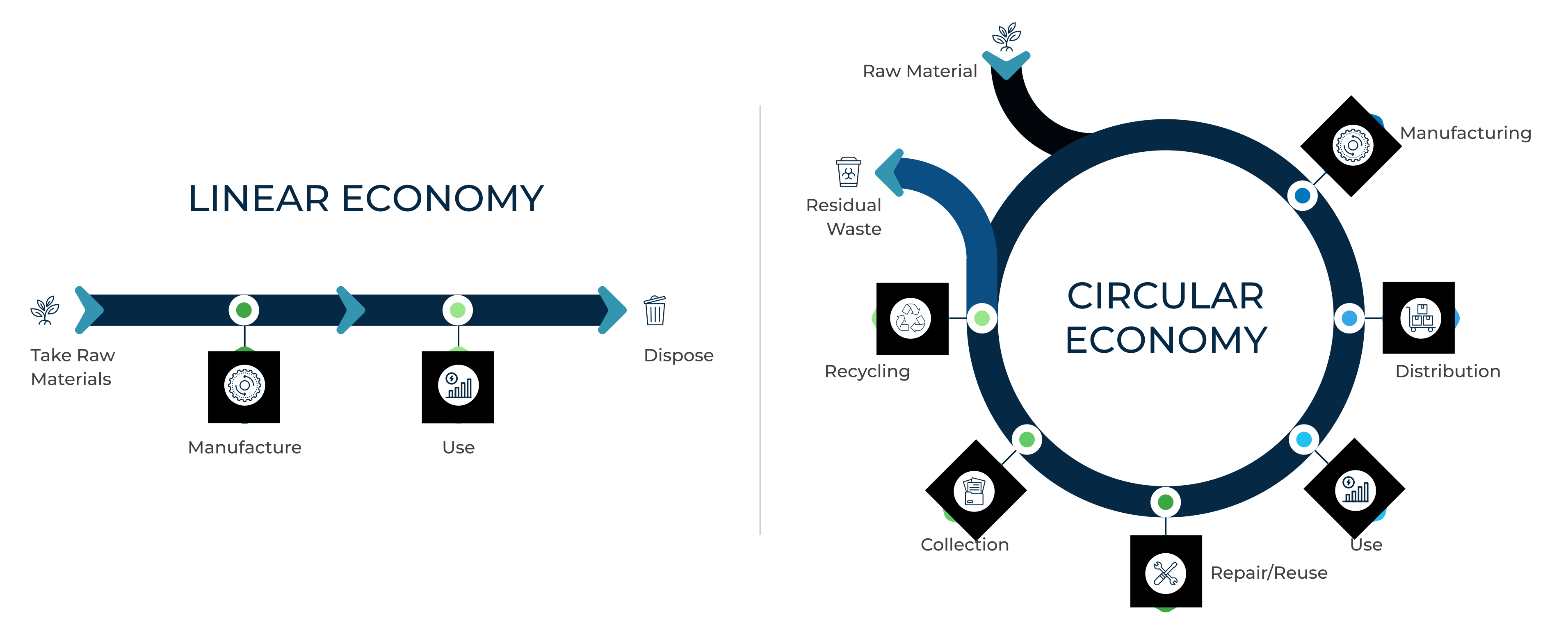
Products sit at the intersection of material extraction, manufacturing emissions, consumer use, and waste. As a result, they have become a focal point for policymakers and standard-setters seeking real, measurable progress on sustainability and climate goals.
Circularity addresses this challenge head-on by emphasizing durability, repairability, reuse, and material recovery. What’s changed is that circularity is no longer driven solely by voluntary leadership — it’s increasingly embedded in law and formal frameworks.
Regulation Is Making Circularity Non-Negotiable ?
The European Union Leads the Way
The EU has emerged as the global leader for circular product policy. Its Ecodesign for Sustainable Products Regulation (ESPR) fundamentally reshapes expectations for product performance, requiring products placed on the EU market to demonstrate characteristics such as durability, repairability, recyclability, and, in some cases, minimum recycled content.
A cornerstone of ESPR is the introduction of Digital Product Passports (DPPs) — digital datasets that carry standardized product information across the value chain, enabling repair, reuse, and high-quality recycling while increasing transparency.
The EU Batteries Regulation provides an early example of how this plays out in practice: battery passports will require detailed lifecycle, material, and performance data, setting a precedent for other product categories.
Alongside these measures, Extended Producer Responsibility (EPR) schemes continue to expand across packaging, electronics, textiles, and other sectors. By making producers financially and operationally responsible for products at end-of-life, EPR directly incentivizes better upstream design decisions.
Global Ripple Effects
While regulatory approaches vary outside the EU, the impact is global. Multinational companies increasingly design products to meet EU requirements regardless of where they are sold. In the U.S., state-level EPR laws and recycled-content mandates are growing, signaling a broader shift toward lifecycle accountability.
Get Product and Packaging Support
3R’s holistic solutions help you navigate regulations, set practical targets, assess impacts, and innovate for circularity, decarbonization, and efficiency.
Standards: Creating a Shared Framework for Circular Products
As regulation accelerates, standards play a critical role in translating high-level goals into practical guidance and measurable outcomes.
ISO Circular Economy Standards
The ISO 59000 series, published in 2024, represents one of the newest sustainability-focused frameworks from the International Organization for Standardization (ISO). These standards provide a global foundation for understanding and implementing circular economy principles across organizations and value chains. The ISO 59000 series represents a foundational set of global standards for the circular economy, establishing:
- ISO 59004: Vocabulary, principles, and guidance for implementation
- ISO 59020: Measuring and assessing circularity performance
- ISO 59010: Guidance on transitioning business models and value networks
- Additional standards (like ISO 59040 for product circularity data sheets) are in development to support harmonized, quantifiable approaches to material flows and circular practices.
These standards provide a common language and methodology that help organizations translate circular ambitions into strategic decisions, operational measurement, and credible disclosure.
The Global Circularity Protocol
A major development in the landscape is the Global Circularity Protocol for Business (GCP) — a science-based framework developed by the World Business Council for Sustainable Development (WBCSD) with the One Planet Network (hosted by UNEP) and backed by dozens of corporations from diverse sectors. The GCP aims to provide a standardized, interoperable way to measure, manage, and communicate circular performance and impacts — whether at product, material, business unit, or corporate level.
The GCP aligns with existing reporting systems (e.g., GRI, ESRS, IFRS, ISO 59020, and the GHG Protocol) and is designed to support business integration of circularity while enabling comparable, decision-useful disclosures.
Several multinational companies have already contributed to the protocol’s development and pilot testing, including organizations such as Philips, Toyota, Panasonic, and IKEA. Their participation helps translate circular economy concepts into practical measurement and reporting approaches that can be applied across complex global supply chains.
Certifications: Signaling Leadership and Raising the Bar
Voluntary certifications continue to shape market expectations and push innovation beyond compliance.
Cradle to Cradle Certified® & Circularity Pathways
The Cradle to Cradle Certified® framework has long been a leading product certification emphasizing material health, circular design, and systems thinking. Its evolving standards now include focused circularity requirements that emphasize circular sourcing, circular design, and circular systems — ensuring products are intentionally designed for next use and active cycling within circular pathways.
3R Sustainability proudly contributed feedback to the latest version of the Cradle to Cradle certification, helping shape criteria that are ambitious, practical, and rooted in real-world application.
Such certifications not only validate circular leadership in the marketplace but also help companies prepare for emerging regulatory requirements, including compliance with ESPR and Digital Product Passport expectations.
Corporate and Sector-Level Frameworks
Frameworks such as B Corp standards now include circularity and environmental stewardship criteria, while organizations and sector partnerships (e.g., U.S. Plastics Pact, Ellen MacArthur Foundation’s New Plastics Economy, Circular Electronics Partnership) are embedding circular practices into industry norms.
Beyond Rules: Initiatives Accelerating Circular and Climate Action
The Exponential Roadmap Initiative
The Exponential Roadmap Initiative (ERI) is a science-based collaboration aligned with the Carbon Law — the principle that global emissions must be halved every decade to stay within 1.5 °C pathways. ERI brings together companies and partners to accelerate climate action across value chains, and circularity is a core lever within this work, recognized for its potential to reduce emissions through material optimization, reuse, and system redesign.
What This Means for Product Companies
For product companies, the message is clear: circularity is no longer a standalone sustainability initiative. It is becoming a core design, data, and compliance requirement.
This shift demands:
- Early integration of circular principles into product design
- Robust lifecycle and material flow data
- Cross-functional collaboration across design, sourcing, compliance, sustainability, and finance
While the landscape may seem complex, the underlying direction is consistent: regulators, standards bodies, certification programs, and industry initiatives are all converging on credible, measurable, and actionable circularity.
Looking Ahead
Digital Product Passports will expand across more industries. ISO and GCP frameworks will mature, deepening the interoperability of circular performance data with financial and ESG reporting. As climate commitments continue to intertwine with material strategy, companies with early, systematic circularity integration will be well positioned for both compliance and competitive differentiation.
Circularity is no longer just about reducing waste — it’s about designing products that deliver resilience, transparency, and long-term value.
How 3R Sustainability Can Support You
At 3R Sustainability, we help organizations navigate this evolving landscape by:
- Assessing product and portfolio circularity against emerging regulations and standards
- Translating standards frameworks into practical implementation roadmaps that work across design, supply chain, and compliance teams
- Supporting data strategies that prepare your organization for Digital Product Passports, circular reporting, and sustainability disclosures
- Advising on credible certification pathways
Whether you’re preparing for mandatory compliance or seeking to demonstrate leadership, we partner with you to turn complexity into clarity and action.
Let’s talk about where your organization is on its circular journey and how we can accelerate impact together.