

By Ian Kay
Recyclability labels are everywhere – but for years, they’ve often caused more confusion than clarity. California Senate Bill 343 (SB 343), also known as the Truth in Labeling law, is designed to change that.
By setting clear, enforceable rules around when packaging can be labeled as recyclable, SB 343 is redefining how brands communicate sustainability claims on pack. The goal? Reduce consumer confusion, improve recycling outcomes, and ultimately strengthen the circular economy.
Here’s what brands need to know – and why this law matters far beyond California.
Why SB 343 Exists: A Labeling System That Stopped Working
Recycling in the U.S. has struggled to keep pace with the explosion of plastic packaging. While recycling rates increased steadily through the 1980s and 1990s, progress has largely stalled over the past two decades. Today, only about 9% of plastic ever produced has been recycled, and just a fraction of that has been recycled more than once. The rest — roughly 60% of all plastic ever made — now sits in landfills or the natural environment.
At the same time, consumer trust in recycling labels has eroded.
Research shows that 78% of consumers look to packaging for recycling guidance, yet nearly two-thirds say the information is confusing. In live consumer tests, participants were frequently unable to identify whether common items like plastic bags, food pouches, or chip bags were recyclable. In some cases, over 80% of consumers were either wrong or unsure.
When people don’t know what to do, they often rely on visual cues — especially the familiar “chasing arrows” symbol — assuming it means a package belongs in the recycling bin. Unfortunately, that assumption is often incorrect. This well-intentioned guesswork leads to higher contamination rates, making recycling systems less efficient and more expensive to operate.
SB 343 was created to close this gap between what consumers think is recyclable and what recycling systems can actually process. By limiting recycling claims to materials that are widely collected, sorted, and reprocessed in California, the law aims to reduce contamination, improve recycling outcomes, and restore credibility to on-pack sustainability claims.
What SB 343 Does
SB 343 restricts when recyclability claims — including the chasing arrows symbol — can appear on packaging sold in California.
Under the law, a package can only be labeled as recyclable if it meets specific, statewide criteria confirming that the material is widely recycled in practice, not just in theory.
To qualify as recyclable, a material must be:
- Collected by recycling programs serving at least 60% of California’s population
- Sorted into a defined recycling stream at large-scale material recovery facilities serving at least 60% of collection programs.
- Reprocessed into raw material for new products
- Designed for recycling, meaning inks, adhesives, labels, and components don’t interfere with recycling systems
- Free of harmful substances, including heavy metals and intentionally added PFAS above regulated thresholds (100 ppm)
SB 343 also changes how resin identification codes (RICs) can be displayed. Plastic resin numbers (1–7) should no longer appear inside chasing arrows and should be displayed with an equilateral triangle, helping separate resin identification from recyclability claims.
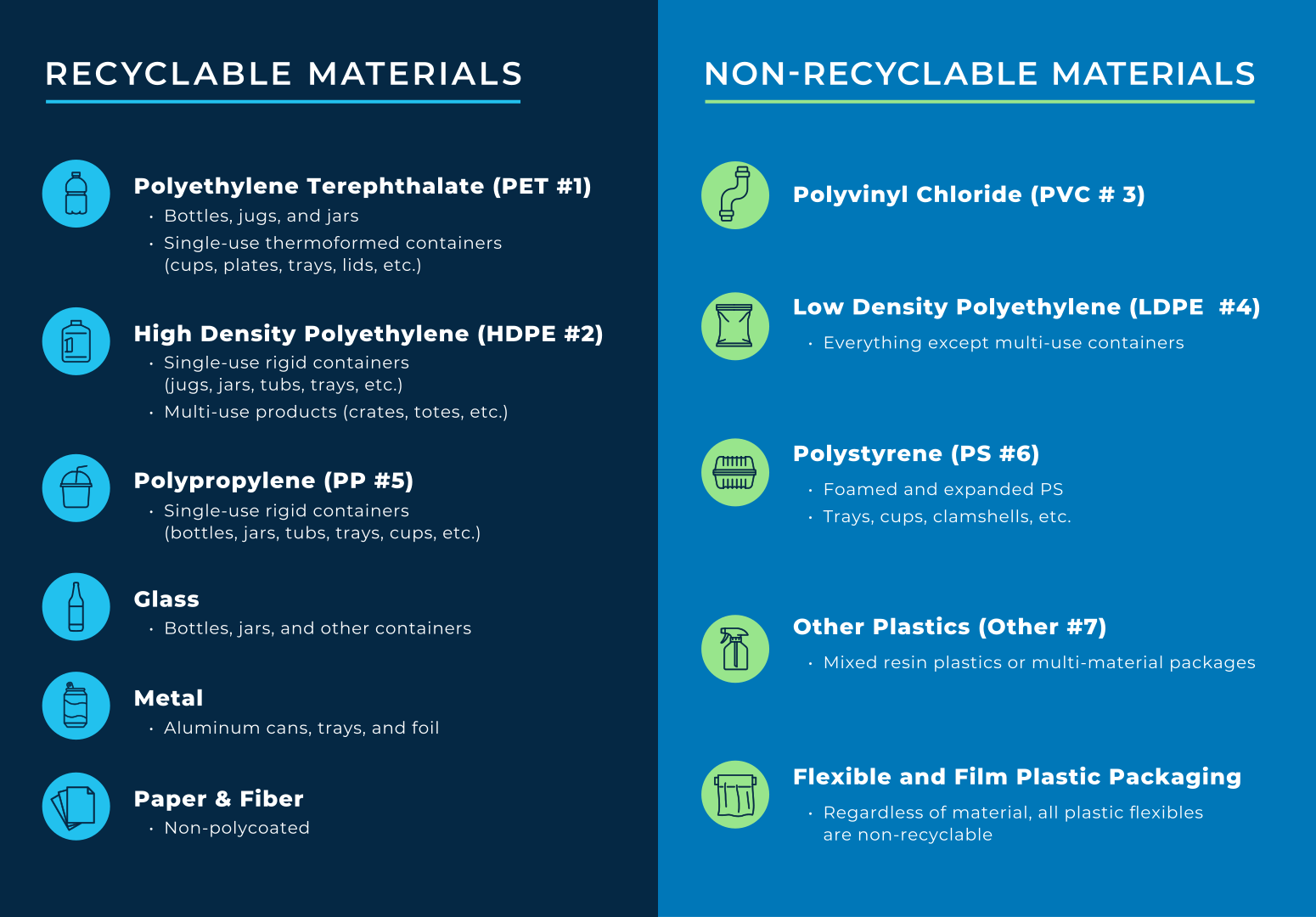
What Materials Are Considered Widely Recyclable?
Outlined below are the materials that are generally considered widely recyclable, though each package and product should be evaluated on a case-by-case basis.
Recyclable Materials
Polyethylene Terephthalate (PET #1)
- Bottles, Jugs, and Jars
- Single-use thermoformed containers (Cups, plates, trays, lids, etc.)
High Density Polyethylene (HDPE #2)
- Single-use rigid containers (jugs, jars, tubs, trays, etc.)
- Multi-use products (crates, totes, etc.)
Polypropylene (PP #5)
- Single-use rigid containers (bottles, jars, tubs, trays, cups, etc.)
Glass
- Bottles, jars, and other containers
Metal
- Aluminum cans, trays, and foil
- Tin cans
Paper & Fiber
- Non-polycoated
Non-Recyclable Materials
Polyvinyl Chloride (PVC # 3)
Low Density Polyethylene (LDPE #4)
- Everything except multi-use containers
Polystyrene (PS #6)
- Foamed and expanded PS
- Trays, cups, clamshells, etc.
Other plastics (Other #7)
- Mixed resin plastics or multi-material packages
Flexible and Film plastic packaging
- Regardless of material. All plastic flexibles are non-recyclable
Importantly, SB 343 does not allow alternative claims like “check locally” or “store drop-off.” If a package isn’t widely recyclable, recycling claims simply can’t appear.
What This Means for Brands and CPG Companies
Any company selling packaged products in California must comply with SB 343 for products manufactured on or after October 4, 2026.
Noncompliance carries real risk. Under the California “Business and Profession” code, violations can result in enforcement actions, including misdemeanor charges punishable by up to six months in county jail, a fine of up to $2,500 per violation, or both. But beyond penalties, SB 343 has broader implications for packaging strategy:
- Packaging choices now directly affect labeling eligibility
- Some materials will lose the ability to communicate recyclability altogether
- Brands may need to redesign packaging to maintain sustainability claims
- Cleaner recycling streams can increase access to post-consumer resin (PCR), supporting recycled content and EPR goals
In short, SB 343 makes recyclability claims something brands must earn, not assume.
3R Support
At 3R Sustainability, we support producers in assessing compliance risk under SB 343 and implementing practical, forward-looking solutions to address current and future on pack claim restrictions.
Our services include:
- Portfolio assessment: Comprehensive evaluation of a company’s packaging portfolio to identify SB 343 compliance risks.
- Packaging guidance: Strategic recommendations to help future-proof packaging by transitioning to materials that are widely recyclable and eligible for on-pack claims.
- Claim substantiation support: Development of substantiation documentation to support compliant recycling claims.
SB 343 is a shift – but it’s also an opportunity. Brands that act early can reduce risk, improve recyclability outcomes, and build trust with consumers through clearer, more honest packaging.
References:
- (2021). Senate Bill No. 343 (SB 343): Environmental advertising: recycling symbol: recyclability: products and packaging. Sacramento, CA, State of California.
- (2025). APR Design Guide for Plastics Recyclability. R. Association of Plastic. Washington, DC, Association of Plastic Recyclers.
- (2025). Accurate Recycling Labels (SB 343). R. California Department of Resources and Recovery. Sacramento, CA, CalRecycle.
- California Department of Resources, R. and Recovery (2025). SB 343 Material Characterization Study Final Findings – 2023/2024. Sacramento, CA, California Department of Resources Recycling and Recovery (CalRecycle).
- Geyer, R., et al. (2017). “Production, use, and fate of all plastics ever made.” Science Advances 3(7): e1700782.