


In Part II of our LEED v5 O+M webinar series, the 3R Sustainability team walked through two of the most consequential performance areas of the updated rating system: Energy and Atmosphere and Water Efficiency. USGBC announced last week that the deadline to register projects under LEED v4.1 has been extended to June 30, 2027, giving organizations additional time to assess gaps and put in place the policies and data collection needed before committing to LEED v5.
Many of the most important preparation steps for this rating system carry long lead times. While LEED has always pushed for market transformation, adoption is critical to see that change takes hold.
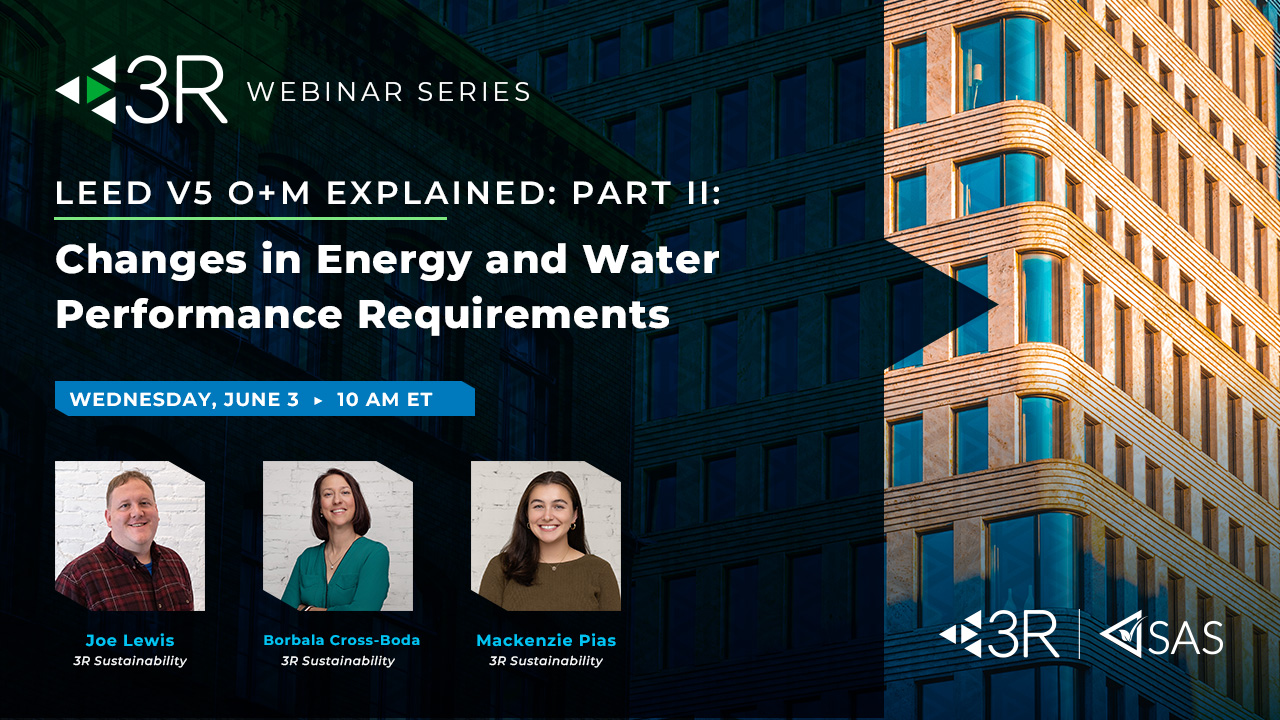
Watch the webinar on LEED v5 O+M Part 2
3R covers new expectations for operational performance and reporting ahead of required adoption in June 2026, with a focus on energy and water.
The End of the Black Box Era
The calculation methodology for LEED v4.1 Energy and Water performance credits is widely described as a black box. You enter all the required data — population, weekly hours of operation, and so on — and it generates your score, with little transparency into what the benchmark value actually represents. This made it difficult for facility managers to distinguish changes in usage driven by occupancy from inefficiencies that needed to be addressed.
A Restructured Approach to Water Efficiency
Under LEED v4.1, Water Efficiency was a single combined credit worth up to 15 points. LEED v5 restructures the category into three distinct components:
- Water Metering & Reporting — a new prerequisite requiring metering of all potable and alternative water sources, tracked separately.
- Water Performance — an optional credit worth up to 14 points, scored by building use type and annual water use per unit of area.
- Advanced Water Metering — an additional one-point credit for sub-metering at least two building systems.
The shift to building-type-specific water consumption limits gives teams far more transparency into how points are calculated. However, the new requirements include alternative sources like rainwater capture in the calculation, which appears to be at odds with the new construction rating system that has encouraged these features for years.
LEED v5 also formalizes the connection between water efficiency and broader organizational goals. The annual USGBC data-sharing requirement produces audit-ready documentation that feeds directly into GRESB and CDP reporting, making metering infrastructure a useful investment across multiple reporting fronts.
The prerequisite sets a minimum operational bar: metering must be in place and continuous 12-month data collection must begin with no gaps. One missed month restarts the reporting clock.
Get LEED Support
At 3R, our New Building Certifications team delivers unparalleled expertise in LEED and BREEAM consulting. Reach out to us today.
New Energy Performance Requirements: A Hierarchy of Flexibility
The LEED v5 energy performance credits now rely on outside benchmarks and standards rather than the internal adjustments in v4.1. These approaches are arranged in a hierarchy of preference based on each methodology's flexibility to address real-world operating conditions.
Option 1: Energy Star Portfolio Manager is the default for most building types. The system covers more than 85 property types and is designed to account for unique operating parameters like high-process loads, occupancy density, and building-type-specific equipment. A minimum score of 60 satisfies the Minimum Energy Performance prerequisite; a score of 69 earns the first credits; and a score of 92 earns the maximum 12 points. A minimum of seven energy points is required to qualify for Platinum.
Option 2 uses ASHRAE 100-2024 Appendix B Energy Use Intensity targets. Preference is given to international projects and building types not covered under Option 1. It offers only limited process load and occupancy-based adjustments.
Option 3 allows the use of 12 months of calibrated historical data and is reserved for high-process-load facilities not addressed by the first two options, such as manufacturing facilities or stadiums.
Refrigerant Management: Moving the Credit to the Prerequisite
LEED v5 O+M takes the accounting portion of LEED v4 EAc Enhanced Refrigerant Management Option 2 and makes it a prerequisite, requiring:
- A complete refrigerant inventory by equipment type and refrigerant weight.
- A documented leakage management policy complying with applicable local regulations.
- Annual visual inspections and leak correction records.
From our experience, this is something most building operations teams already do — either internally or through their HVAC contractor. The requirements push teams to codify what they have been doing to comply with governmental standards. One important note: these requirements cover all refrigerant equipment with no minimum weight threshold, so the breakroom refrigerator technically belongs in the inventory.
Beyond the prerequisite, teams can earn additional credits based on their leakage emissions ratio: multiply the amount of each refrigerant recharged by its global warming potential, sum those products, and divide by the total weight of all refrigerants on site. A ratio below 50 earns one point; below 25 earns two. Tracking recharge amounts integrates naturally into existing HVAC contractor workflows.
Electrification as a Scoring Strategy
One of the clearest incentive signals in LEED v5 O+M is the treatment of electrification in the GHG performance credits. All-electric buildings earn five GHG performance points with no additional documentation required. The credit is designed to reward incremental steps toward electrification, not just full transitions — making sequenced planning a viable approach for most portfolios.
Greening the grid is also worth considering as a long-term strategy. The GHG performance credits allow teams to claim credit for both on-site and off-site renewables. Investing in renewables in your local grid can establish a feedback loop: teams can also claim credit for operating in a grid with a lower emissions factor than the national average, earning additional points in the process.
Preparing for LEED v5
Many of the requirements in LEED v5 O+M build on infrastructure and practices that organizations may already have partially in place. The primary challenge is often formalizing what exists, identifying gaps, and ensuring continuous data collection is underway well before registration.
The organizations best positioned for the LEED v5 transition will be those that:
- Confirm metering infrastructure is in place for all potable, alternative, and energy sources.
- Establish or update a documented refrigerant management policy and complete a full inventory.
- Begin 12-month continuous data collection — and set up utility APIs where possible to automate tracking, particularly in multi-tenant buildings.
- Run building energy data through EPA Portfolio Manager to establish a performance baseline and identify the right scoring option.
- Identify electrification opportunities that can be sequenced over time as equipment reaches end of life.
- Engage cross-functional teams early — facility managers, operations staff, and sustainability leads all play a role in v5 documentation and data collection.
3R Sustainability’s Built Environment team supports organizations through every stage of LEED v5 preparation, from initial gap analysis and scorecard modeling to metering strategy, energy performance modeling, and full certification submission.
Ready to assess your building’s LEED v5 readiness? Contact the 3R team or watch the full webinar recording.