


Scope 3 inventories are an important starting point for climate strategy. They help companies identify where emissions are concentrated across the value chain, including purchased goods and services, transportation, product use, and end-of-life treatment.
But for many teams, that is where the challenge begins.
A Scope 3 inventory may show that a category is high-emitting, but it often does not explain which products, materials, suppliers, design choices, or use-phase assumptions are driving the result. Without that level of detail, companies can struggle to move from emissions measurement to practical decarbonization action.
That was the focus of 3R Sustainability’s July 28 webinar, “From Measurement to Action: Leveraging Product Carbon Footprints for Scope 3 Decarbonization.” The core message was clear: Product Carbon Footprints, or PCFs, can help companies turn Scope 3 category-level insight into product, supplier, design, roadmap, and reporting decisions.
Key takeaways
- Scope 3 inventories locate emissions across categories, suppliers, and value-chain stages.
- Product carbon footprints explain why emissions occur at the product level.
- PCF evidence becomes useful when it connects hotspots to owners, levers, data quality, and governance.
- Reporting and product claims need traceable, caveated evidence rather than unsupported claims.
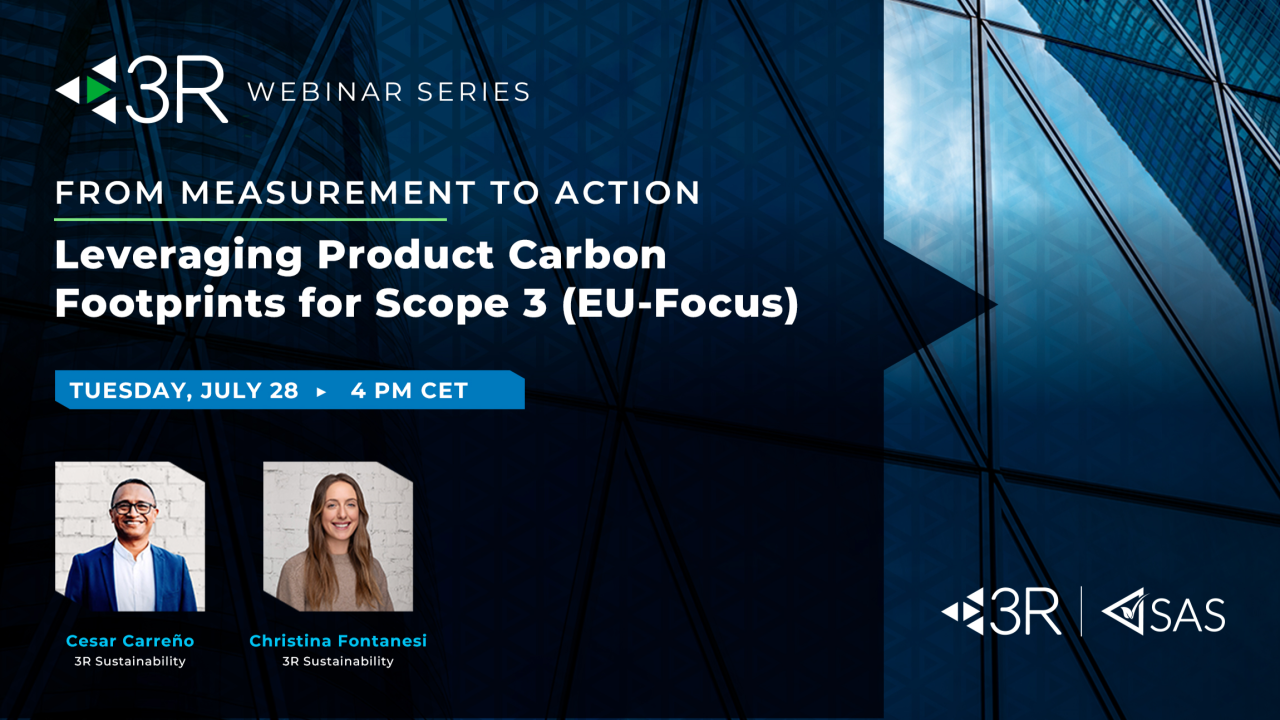
Watch the recording
3R experts discuss how organizations are using PCFs to support supplier engagement, product innovation, decarbonization roadmaps, and climate reporting.
Scope 3 tells companies where to look. PCFs help explain what to change.
Scope 3 is the corporate inventory lens. It shows emissions across upstream and downstream value-chain activities and helps leaders understand which categories, suppliers, or value-chain stages deserve attention.
A Product Carbon Footprint takes a more specific lens. It quantifies greenhouse gas emissions and removals associated with a defined product over a stated life-cycle boundary. A useful PCF clarifies the functional or declared unit, system boundary, activity data, allocation rules, emission factors, assumptions, and data-quality expectations.
That distinction matters. Scope 3 can show that purchased goods and services are material. A PCF can help identify whether emissions are driven by input materials, manufacturing energy, logistics, product use, end-of-life treatment, or a combination of factors. The two tools are strongest together: the Scope 3 inventory sets the enterprise priority; PCFs show the product decisions that can move it.
A useful PCF is more than a carbon number.
One of the most important takeaways from the webinar was that a PCF should not be treated as a standalone calculation. A strong PCF provides three things:
A baseline — a product-level emissions result tied to a defined unit, life-cycle boundary, and methodology.
A breakdown — visibility into the emissions drivers across materials, manufacturing, logistics, use, and end-of-life, depending on the product boundary.
A path to action — supplier, design, operations, and reporting levers connected to those hotspots.
The number matters, but the value is in the decision-ready detail behind it. A PCF becomes useful when it helps teams understand what is driving emissions, who can influence those drivers, and what actions are credible based on the data quality and methodology.
Turning hotspots into owners and levers
PCF results become actionable when hotspots are connected to business owners.
For example, if purchased materials are a major hotspot, procurement and R&D may need to work with suppliers on primary data, lower-impact inputs, recycled content, or specification changes. If manufacturing energy is a major driver, operations teams may need to evaluate process efficiency, renewable energy, yield improvement, or capital investments. If product use is significant, product teams may need to assess efficiency redesign, durability, or customer use assumptions.
The key question is not only “Where are the emissions?” It is “Who can change the driver, and through which decision process?”
This is where PCFs can support supplier engagement, product innovation, and roadmap prioritization. They help companies move from broad climate ambition to a practical sequence of interventions based on reduction relevance, feasibility, data quality, and ownership.

Get Product and Packaging Support
3R's holistic solutions help you navigate regulations, set practical targets, assess impacts, and innovate for circularity, decarbonization, and efficiency.
Supplier engagement improves when data requests are specific
PCFs help companies move from broad supplier emissions requests to product-specific asks. Once Scope 3 data identifies priority suppliers or products, teams can request activity data, emission factors, and process details, then validate boundaries, allocation methods, recency, and representativeness.
The strongest supplier programs use that evidence for action, not just data collection. PCF results can help identify reduction opportunities, set a refresh cadence, and connect supplier progress back to Scope 3 reporting. This turns supplier engagement into a practical decarbonization process: ask for the right evidence, validate it, act on hotspots, and track progress over time.
EU reporting and product rules raise the stakes
The webinar also connected PCFs to reporting and regulatory relevance. CDP responses, CSRD and ESRS reporting, product transparency expectations, green claims rules, and customer requests increasingly reward credible evidence. In the EU, Digital Product Passport expectations under the Ecodesign for Sustainable Products Regulation are also pushing companies toward more traceable product data.
For carbon-intensive imports, the European Commission describes CBAM as a tool to address carbon leakage by ensuring import prices reflect embedded carbon emissions. PCFs do not replace corporate greenhouse gas inventory controls, but they can strengthen the evidence base behind Scope 3 narratives, supplier actions, product claims, and transition planning.
Where companies should start
3R recommends starting with products where Scope 3 exposure, supplier influence, and decision relevance overlap. From there, companies can build PCFs with clear boundaries and data-quality rules, translate hotspots into supplier or product interventions, govern the results through refresh and claims-review processes, and eventually scale the approach across product families.
The goal is a repeatable operating model. When sustainability, procurement, product, finance, operations, and legal teams can use the same PCF evidence, product carbon data becomes a bridge between climate ambition and decisions people can own.
Connect with 3R
If your team is being asked for product carbon footprints, LCA support, supplier data, or claim-ready evidence, 3R Sustainability can help you choose the right pilot, build the PCF, validate assumptions, and turn the results into practical next steps. Reach out to us today.