


In our recent webinar, LEED v5 O+M Explained – What is New and What to Do Next, the 3R Sustainability team explored one of the biggest evolutions to the LEED Operations + Maintenance (O+M) rating system in years. An emphasis on three foundational pillars: Decarbonization, Quality of Life, and Ecological Conservation and Restoration.
LEED has always pushed for market transformation through its performance standards. LEED v5 introduces a more integrated approach that looks beyond a building’s four walls. The reimagined rating system prerequisites place more focus on climate resilience, occupant wellbeing, operational transparency, and cross-functional collaboration.
For organizations preparing for certification or recertification, understanding these changes early will be critical—especially with the June 30, 2026, transition deadline approaching for new LEED v4/v4.1 registrations.
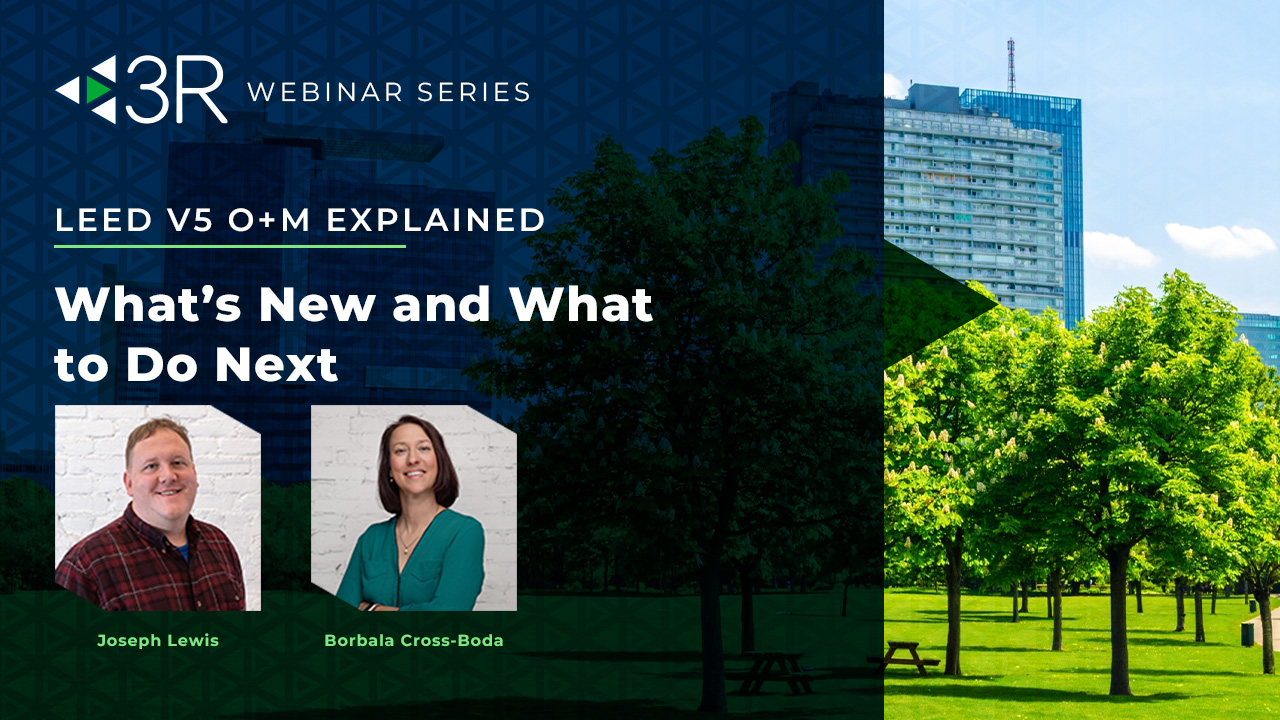
Watch the webinar on LEED v5 O+M Part 1
3R unpacks one of the most significant updates to LEED v5 O+M: the new Integrative Process, Planning, and Assessments category. We’ll break down what’s new, why it matters, and how to approach these requirements strategically, so you can move from awareness to action with confidence.
A More Holistic Approach to Building Operations
One of the biggest shifts in LEED v5 O+M is the brand-new Integrative Process, Planning, and Assessment section. The four new prerequisites focused on long-term operational strategies:
- Climate Resilience Assessment
- Human Impact Assessment
- Operations Assessment & Policy
- Current Facilities Requirements + O&M Plan
Together, these prerequisites are designed to provide more transparency and help organizations better understand how operations will continue operating under future environmental and social pressures.
As discussed during the webinar, LEED v5 also encourages more cross-disciplinary collaboration by incorporating social and governance considerations throughout the rating system—not just operational performance.
Climate Resilience Becomes a Core Requirement
Perhaps the most significant new prerequisite is the Climate Resilience Assessment. Building teams are now expected to identify site-specific climate hazards, evaluate risk and vulnerability, and develop operational response strategies using future climate scenarios from the Intergovernmental Panel on Climate Change (IPCC) using the shared socioeconomic pathways.
Importantly, the requirement is less about predicting the future perfectly and more about creating actionable plans.
As highlighted during the session, organizations should focus on:
- Identifying priority climate hazards.
- Developing short-term and long-term response strategies.
- Defining operational triggers for implementation over temporal triggers.
Incorporating resilience planning into ongoing operations and maintenance.
For example, an operations team addressing extreme heat events may plan for short-term solutions such as adjusting operating schedules and improving emergency preparedness protocols. The long-term plan may include increased HVAC cooling capacity for future climate conditions on replacement.
The broader goal is to ensure facilities are better prepared for increasing climate-related disruptions while maintaining occupant safety and operational continuity.
Expanding the Definition of Building Performance
Another major addition to LEED v5 O+M is the Human Impact Assessment, which introduces a strong focus on the social context surrounding buildings and operations.
Projects are now required to evaluate factors such as:
- Community demographics and accessibility
- Public transportation and green space access
- Worker wellbeing and indoor environmental quality
- Community health and safety considerations
- Supply chain and labor-related impacts
Rather than viewing buildings strictly through a technical lens, LEED v5 pushes teams to think more broadly about how facilities impact occupants, workers, and surrounding communities.
The webinar also highlighted new tools and templates from USGBC and GBCI that can help organizations complete these assessments more efficiently.
Get LEED Support
At 3R, our New Building Certifications team delivers unparalleled expertise in LEED and BREEAM consulting. Reach out to us today.
Operational Policies Move Front and Center
LEED v5 formalizes many operational best practices that organizations may already perform informally.
The new Operations Assessment & Policy prerequisite requires projects to establish codified policies for continued improvement. These policies should each include baseline operational performance, set improvement goals, and assign responsibilities. Policies must be put in place across key operational areas, including:
- Site operations
- Materials purchasing
- Construction and renovation practices
- Occupant needs
- Green cleaning
The emphasis on documentation is intentional. O+M v5 is designed to support ongoing performance management rather than one-time certification efforts.
Similarly, the Current Facilities Requirements + O&M Plan prerequisite requires organizations to maintain up-to-date operational documentation, including:
- Equipment schedules and setpoints
- Sequences of operation
- Preventive maintenance plans
- Ongoing commissioning activities
These documents are expected to function as “living documents” that evolve alongside building operations and maintenance.
Resilience and Worker Safety Gain Additional Recognition
Beyond the required prerequisites, new optional credits are introduced, focusing on operational resilience and worker safety.
The Operational Planning for Resilience credit encourages organizations to formalize emergency response procedures, communication protocols, evacuation planning, backup systems, and support for vulnerable populations.
Meanwhile, the Worker Safety and Training credit emphasizes operational safety plans, employee training, PPE procedures, emergency preparedness, and ongoing safety education.
These additions reinforce a broader theme: sustainability performance is increasingly tied to organizational resilience and human-centered operations—not just resource efficiency.
Preparing for LEED v5
For many organizations, the transition to LEED v5 may feel significant at first. But as emphasized throughout the webinar, many of these new requirements build upon practices that organizations may already have partially in place. The key challenge is often formalizing, documenting, and integrating them into a cohesive operational framework.
The organizations best positioned for success will be those that:
- Start assessing gaps early.
- Engage cross-functional teams.
- Use available templates and tools.
- Engage a LEED sustainability consultant.
- Engage a third party sustainability team where additional support is needed.
Treat it as an operational improvement framework—not just a certification exercise
Ultimately, LEED v5 O+M reflects where the built environment industry is heading: toward buildings that are not only efficient but also resilient, adaptable, and aligned with the needs of employees and the surrounding area.